
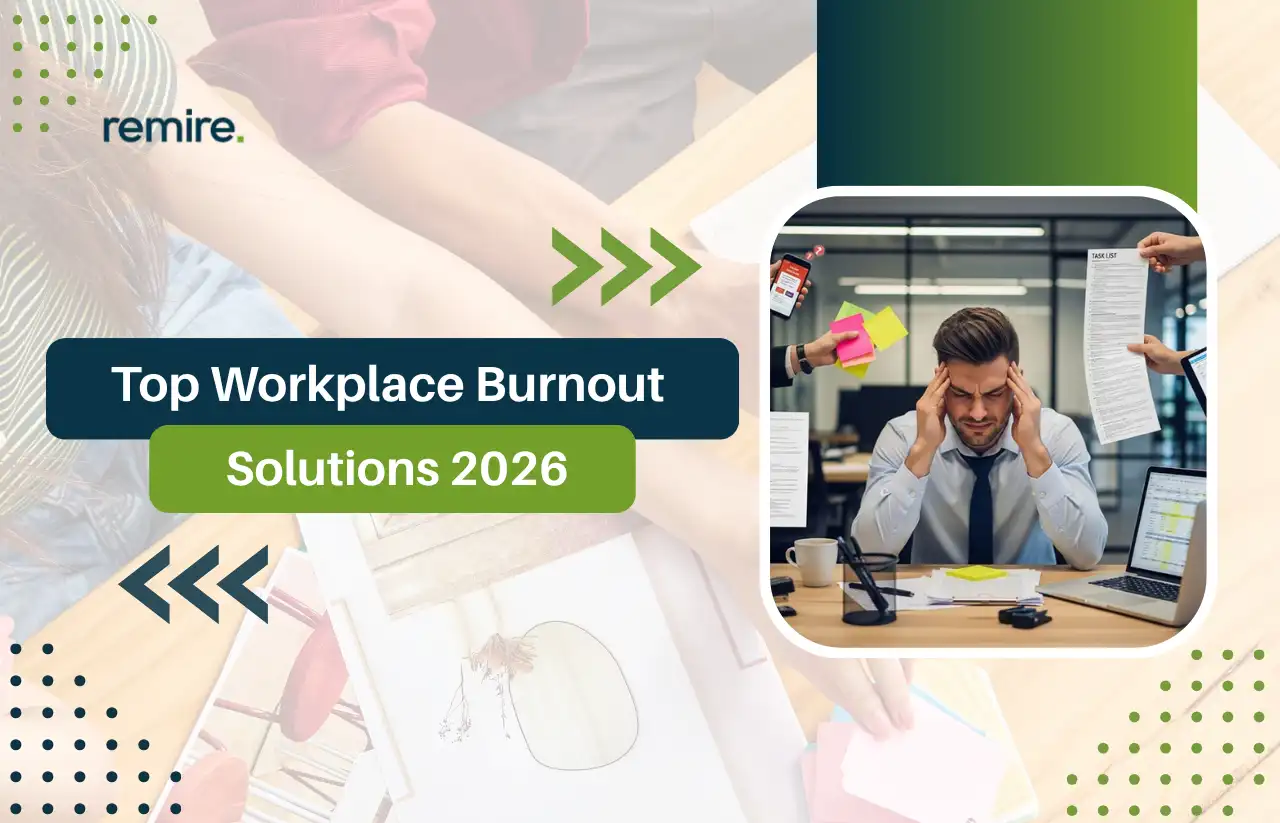

More than 75% of workers worldwide report experiencing some degree of burnout in 2026 (DHR Global’s Workforce).
That number alone should stop any HR leader in their tracks. But the follow-up statistic is even more alarming: only 1 in 4 workers feel their employer genuinely prioritizes mental health support.
Burnout is no longer an individual resilience problem. It is a structural, organizational, and strategic failure, one that costs the global economy an estimated $322 billion annually in lost productivity and U.S. employers alone $190 billion in stress-related healthcare costs (WHO).
The good news: burnout is largely preventable. Research consistently shows that organizations that invest in the right strategies, tools, and cultural changes can cut voluntary turnover by 25–40% (Meditopia).
This guide from Remire, a global HR solution, provides HR professionals, people leaders, and business owners with a complete, evidence-based playbook of the top workplace burnout solutions available in 2026. It covers everything from early detection tools to structural workforce redesign.
What Is Workplace Burnout? Definition, Scope, and Why It Matters
Workplace burnout is a state of chronic occupational stress that has not been successfully managed. The World Health Organization officially classifies it as an occupational phenomenon in the ICD-11, not a medical condition, but a direct product of the work environment.
The WHO defines burnout across three core dimensions:
- Exhaustion: Depleted energy and physical or emotional fatigue that doesn’t recover with rest.
- Cynicism and mental distance: A growing negativity, detachment, or emotional numbness toward work.
- Reduced professional efficacy: A persistent sense that your work no longer matters or that you can’t do it well.
How Burnout Differs from Stress, Anxiety, and General Overwork
These terms are frequently confused, and conflating them leads to the wrong interventions.
- Stress is typically temporary and situation-specific. It resolves when the stressor is removed.
- Anxiety is a clinical mental health condition with physiological components that extend beyond work.
- Overwork is a situational state of excessive workload that can be addressed through task reduction.
- Burnout is a chronic, systemic state that develops over months. It doesn’t resolve with a single vacation or weekend rest, it requires organizational and behavioral change.
Understanding this distinction matters because effective solutions for work-related burnout must address systemic causes, not just provide relief for symptoms.
Common Signs of Burnout: How to Recognize It Early
Early detection is the difference between a one-week intervention and a six-month recovery. How to recognize employee burnout early is one of the most critical skills any manager or HR professional can develop.
Physical, Emotional, and Behavioral Red Flags
Physical signs:
- Persistent fatigue that doesn’t improve with rest or time off
- Frequent illness (lowered immunity from chronic stress)
Sleep disturbances either insomnia or excessive sleep - Headaches, muscle tension, gastrointestinal issues
- Dramatic change in appetite or weight
Emotional signs:
- Emotional detachment from work, colleagues, and outcomes
- Cynicism, sarcasm, or dismissiveness that was previously absent
- Feeling helpless, trapped, or that effort is wasted
- Reduced sense of personal accomplishment
- Increasing irritability or emotional volatility
Behavioral red flags:
- Declining output quality and increasing errors
- Skipping meetings, avoiding communication, or withdrawing socially
- Taking more sick days or coming in late repeatedly
- Procrastinating on tasks they previously handled confidently
- Quiet disengagement doing the minimum and no more
High-Risk Roles, Demographics, and Organizational Triggers to Watch
While burnout can affect anyone, certain groups carry disproportionate risk in 2026:
- Gen Z (18–24) consistently reports some of the highest levels of workplace stress and burnout compared to older generations. Financial pressure, student debt, and constant digital connectivity are commonly cited factors that intensify this strain and make recovery more difficult. This pattern is widely supported by global workforce research, including the Deloitte Global Gen Z and Millennial Survey
- Millennials (25–40) also report high levels of burnout, with stress often linked to balancing demanding careers alongside caregiving responsibilities such as raising children or supporting family members. (American Phycological Association)
- Managers and middle leaders: Expected to support their teams’ well-being while absorbing pressure from above. A classic squeeze point.
- Remote workers: Struggle with boundary erosion and always-on culture in the absence of physical separation between work and home.
- High performers: Often the last to signal burnout, because their work ethic is the cover story. When they do leave, it surprises everyone.
Self-Assessment Tools and Checklists for Employees and Managers
Validated instruments for measuring burnout risk include the Maslach Burnout Inventory (MBI), the Oldenburg Burnout Inventory (OLBI), and the Copenhagen Burnout Inventory (CBI). Each measures exhaustion and disengagement dimensions with different weights.
Why Workplace Burnout Is Increasing in 2026: Root Causes and Drivers
The burnout crisis of 2026 didn’t emerge from nowhere. Multiple converging forces have made chronic work-related stress the defining workforce challenge of this decade.
Always-On Digital Culture and Information Overload
The boundary between work and personal life has dissolved for millions of workers. 80% of the global workforce, according to Microsoft’s 2025 Work Trend Index, report lacking the time or energy to do their job.
Constant notifications, Slack messages at 9 pm, and the implicit expectation of immediate availability have replaced the 9-to-5 workday with a 24/7 obligation.
This is compounded by information overload. The average knowledge worker switches tasks every 3 minutes, and it takes an average of 23 minutes to fully regain focus after each interruption.
AI-Driven Workforce Anxiety as an Emerging Psychosocial Risk
The rapid adoption of AI tools has introduced a new form of workplace stress: technostress and job displacement anxiety. Workers fear obsolescence, struggle to keep pace with constantly evolving toolsets, and feel pressure to demonstrate AI proficiency they may not yet have.
Ironically, AI tools designed to reduce workload are themselves becoming a source of cognitive burden when poorly implemented. This creates the AI-driven stress cycle, where technology intended to help ends up adding pressure instead.
Work Intensification, Economic Pressure, and Return-to-Office Mandates
The post-pandemic normalization of hybrid and remote work has been partially reversed by return-to-office (RTO) mandates. Research consistently shows that when these mandates are implemented without flexibility or employee input, they can increase the risk of burnout.
Simultaneously, economic pressure is reducing headcount while maintaining or increasing output expectations. Fewer people doing more work for the same or lower real-wage compensation is the structural driver of burnout in 2026.
For organizations managing remote or global teams, employer costs and workforce staffing models play a direct role in how workload is distributed.
Financial Stress, Caregiving Burdens, and Life Stressors Spilling Into Work
Burnout doesn’t start and stop at the office door. Financial stress, which affects an estimated 60% of U.S. workers in 2025, is a major factor impacting employee well-being.
Caregiving responsibilities for children or aging parents, along with global macroeconomic uncertainty, also spill over into the workplace.
Together, these pressures reduce the cognitive resources available for work and lower overall stress tolerance.
Which Industries Face the Most Burnout in 2026?
| Industry | Burnout Rate | Top Driver | Risk Level |
|---|---|---|---|
| Healthcare | 47–69% | Patient load + moral injury | 🔴 Critical |
| Tech / Software | ~64% | Always-on culture + AI anxiety | 🔴 Critical |
| Education | ~58% | Admin overload + under-resourcing | 🔴 High |
| Finance & Banking | ~55% | Long hours + performance pressure | 🔴 High |
| Hospitality / Retail | ~52% | Customer-facing stress + low pay | 🟠 Elevated |
| Legal Services | ~50% | Billable hour pressure + complexity | 🟠 Elevated |
| Manufacturing | ~38% | Shift work + physical demands | 🟡 Moderate |
| Government / Public Sector | ~33% | Bureaucracy + change resistance | 🟡 Moderate |
Sources: WHO, DHR Global Workforce Trends Report, Eagle Hill (2025–2026)
The Real Cost of Burnout for Individuals, Teams, and Organizations
The impact of mental exhaustion on organizational performance is not abstract. It shows up in the numbers on every financial metric that leadership tracks.
📊 $322 billion — annual global cost of burnout-driven productivity losses (WHO)
Source: World Health Organization, 2026
📊 $190 billion — U.S. stress-related healthcare costs annually
Source: The Global Statistics / Speakwise, 2026
📊 76% of U.S. workers report experiencing burnout, 53% at moderate to severe levels
Source: Mind Share Partners, 2025
For the individual, burnout increases the risk of cardiovascular disease, depression, and immune dysfunction. Burned-out employees are 2.6 times more likely to be actively seeking a new job.
For the team, burnout is contagious. When one team member disengages, it shifts the load to others accelerating the burnout cycle across the entire group.
For the organization:
- Turnover cost: replacing a burned-out employee costs 40–200% of their annual salary
- Presenteeism: 40% of burned-out employees show up but function at severely reduced capacity
- Healthcare claims: mental health claims spike 2–3 years after unaddressed burnout periods
- Employer brand: Glassdoor reviews of burnout culture suppress future recruitment quality
Remire’s outsourced recruitment services help businesses rebuild talent pipelines after burnout-driven turnover, but prevention is always the better investment.
Best Workplace Burnout Remedies 2026: Step-by-Step Strategies
These are the best practices for managing burnout at work organized as an eight-step evidence-based framework. Each step is an intervention in its own right, and together they form a complete burnout prevention system.
Step 1: Establish Healthy Work Boundaries and Role Clarity
Ambiguity is a primary driver of chronic stress. When people don’t know exactly what is expected of them, or carry responsibility without authority, cognitive load surges and recovery becomes impossible.
- Define clear job responsibilities with written role descriptions updated at least annually
- Set explicit boundaries around out-of-hours communication (right to disconnect policies)
- Eliminate role overlap and competing priorities by clarifying decision rights
- Create escalation paths for workload concerns that don’t require self-advocacy under pressure
For organizations managing distributed teams, a clear notice period and full-time hours expectations form the baseline of role clarity.
Step 2: Promote Work-Life Integration Through Flexible Work Arrangements
The evidence is clear: flexibility reduces burnout. Remote workers report a 94.2% retention rate vs 81.6% for fully office-based employees. But flexibility without structure creates its own form of always-on pressure.
Effective flexible scheduling means:
- Core hours model: define overlap windows, free the rest
- Asynchronous-first culture: default to written updates over real-time calls
- Schedule protection: block focus time in calendars as non-negotiable
- Mandate full use of PTO not just make it available
See Remire’s guide to what is a remote job for context on structuring remote arrangements that don’t create invisible overloads.
Step 3: Create Psychological Safety as a Foundation for Burnout Prevention
Psychological safety the belief that you can speak up, make mistakes, or ask for help without punishment is the single most powerful predictor of team health. Without it, burnout signs are hidden until they become exits.
- Train managers to respond to vulnerability with curiosity, not judgment
- Model imperfection from leadership; leaders who admit struggle normalize help-seeking
- Eliminate cultures of overwork as virtue (glamorizing long hours signals unsafety)
- Create structured channels for well-being feedback that don’t require courage to use
Step 4: Foster Recognition, Belonging, and a Culture of Appreciation
Recognition is one of the highest-ROI burnout interventions available. A reduction in giving and receiving recognition leads to increased odds of burnout by 45% and 48%, respectively. (O.C. Tanner Global Culture Report (2020)
- Implement structured peer-to-peer recognition (not just manager-down)
- Celebrate effort and approach, not just outcomes, which is especially important in high-pressure roles
- Create belonging through team rituals, shared purpose, and visibility of individual contribution
- Connect work to meaning: help employees understand the impact of what they do
Step 5: Encourage Regular Breaks, Micro-Rest, and Energy Recovery
Productivity research consistently shows that regular breaks improve output quality and reduce error rates, yet most burned-out employees work through lunch, skip movement, and take no real recovery time.
- Establish a team norm: no meetings in first and last 30 minutes of the day
- Encourage 90-minute deep work blocks followed by 15-minute recovery windows
- Mandate minimum PTO thresholds not just accrue, but use
- Design physical environments (or virtual equivalents) that support disconnection
Step 6: Invest in Professional Development and Employee Autonomy
Career stagnation accelerates burnout by eliminating a critical buffer: the sense that effort leads somewhere. When employees see a growth path, their relationship with difficulty changes.
- Map every role to visible development tracks with clear criteria
- Offer internal mobility before external hiring, signal investment in existing people
- Give employees meaningful control over how they achieve their objectives; autonomy is protective
- Fund certification, learning, and conference attendance as retention investments
Step 7: Address Workload Imbalances and Role Overload
This is the step most organizations skip, because it requires changing resource allocation, not just attitude. Workload is the leading operational driver of burnout, and it cannot be coached away.
- Conduct workload audits: map actual hours spent per role against contracted expectations
- Identify chronically understaffed teams and quantify the burnout risk mathematically
- Redistribute tasks based on capacity data, not perceived performance
- Use contractor or EOR arrangements to flex capacity during peak demand
Remire’s contractor management and employer of record services give organizations the workforce flexibility to address structural overload without permanent headcount increases.
Step 8: Deploy Structured Stress Management Programs Across the Organization
Individual stress management techniques, mindfulness, exercise, and journalin, are effective supplements but not substitutes for systemic change. Organizations should offer both:
- Evidence-based EAP (Employee Assistance Programs) with clear promotion and easy access
- Manager coaching on recognizing and responding to stress signals
- Financial wellness programs given that financial stress is a top burnout amplifier
- Peer support networks and trained mental health first-aiders
Top 7 Tools and Technologies for Workplace Burnout Prevention
The best effective burnout strategies for workplaces combine strategy with the right digital infrastructure. Here are the seven categories of tools that deliver the most impact and what to look for in each.
| Feature Category | Must-Have | Nice-to-Have | Best For |
|---|---|---|---|
| Pulse Survey Software | 1–4 weeks | $ | Detecting early warning signs |
| Mental Wellness Platforms | 4–8 weeks | $$ | Ongoing clinical support + EAP |
| Recognition Systems | Immediate | $ | Morale, belonging, appreciation |
| Workload Management Tools | 2–6 weeks | $$ | Capacity planning, overload prevention |
| Flexible Scheduling Apps | 1–2 weeks | $ | Work-life integration |
| L&D Platforms | 6–12 weeks | $$ | Autonomy, growth, engagement |
| Async Communication Tools | 1–3 weeks | $–$$ | Remote teams, always-on culture |
| AI Burnout Detection | 2–4 weeks | $$$ | Predictive, early intervention |
| EOR / Workforce Restructuring | 4–8 weeks | $$$ | Global teams, structural overload |
1. Employee Pulse Survey and Feedback Software
Pulse surveys are the earliest warning system for burnout and the most underutilized. Unlike annual engagement surveys, pulse tools capture real-time sentiment shifts before they become crisis-level disengagement.
- What to look for: Short (3–5 question) weekly or bi-weekly check-ins, anonymous options, manager-level dashboards, trend analysis over time
- Leading tools: Workday Peakon, Glint, Leapsome, Culture Amp, 15Five
- Key metric to track: eNPS (Employee Net Promoter Score) a single question that captures sentiment quickly and benchmarks cleanly
Remire’s HRIS platform integrates with leading pulse survey tools, giving HR teams combined people data and sentiment data in one dashboard.
2. Dedicated Mental Wellness and Health Platforms
The shift from token EAP programs to full-spectrum employee mental health solutions is one of the defining workplace trends of 2026. Modern platforms offer clinical therapy, coaching, crisis support, and self-guided resources in a single app.
- What to look for: Clinical validation, therapist access within 48 hours, personalized care pathways, manager-facing analytics (anonymized), ISO 45003 alignment
- Leading tools: Lyra Health, Spring Health, Modern Health, BetterHelp for Business, Headspace for Work, BetterMe Business
- ROI benchmark: Employers offering comprehensive mental health support see 25–40% lower turnover rates and 8% higher ROI on benefits investment
3. Peer-to-Peer Recognition and Rewards Systems
Recognition programs directly address two of the three WHO burnout dimensions: cynicism and reduced efficacy. When employees feel seen, valued, and connected to purpose, both dimensions improve measurably.
- What to look for: Peer-to-peer (not just manager-down), values-aligned categories, points-based rewards, social feed for visibility, manager analytics
- Leading tools: Bonusly, Workhuman, Reward Gateway, Kudos, Lattice (recognition module)
- Implementation tip: Recognition frequency matters more than reward size. Weekly small acknowledgments outperform quarterly large ones.
4. Advanced Capacity and Workload Management Tools
Without workload visibility data, every burnout intervention is a guess. Capacity management tools give HR and operations leaders objective data on who is overloaded, who has capacity, and where structural redistribution is needed.
- What to look for: Real-time workload dashboards, capacity vs. allocation comparison, project-load heatmaps, integration with project management tools
- Leading tools: Resource Guru, Float, Teamdeck, Forecast, Asana (workload view), Monday.com (capacity tracking)
- Key insight: HR leaders estimate 30% of employees are experiencing silent burnout; workload tools surface this before it escalates
For global workforces, Remire’s headcount management resource combined with contractor coordination gives organizations flexible capacity levers that prevent structural overload.
5. Flexible Scheduling and Time-Tracking Applications
The right stress management in workplaces begins with schedule design. Time-tracking tools help organizations identify overwork patterns before they become burnout, and flexible scheduling tools enable the structural changes needed to fix them.
- What to look for: Overtime alerts, PTO utilization tracking, schedule flexibility tools, after-hours work monitoring, integration with payroll
- Leading tools: Hubstaff, Clockify, Toggl Track, Vacation Tracker (with Recharge feature), Rippling
- Key feature: PTO tracking with early warning — employees who don’t take time off are the highest burnout risk. Recharge by Vacation Tracker predicts burnout from rest patterns before symptoms appear
For pay period accuracy and compliant time tracking across jurisdictions, Remire’s payroll management ensures hours worked translate correctly to compensation, reducing financial stress from payroll errors.
6. Continuous Learning and Development (L&D) Platforms
Career stagnation is a direct precursor to burnout. Employee retention strategies that include meaningful L&D investment reduce burnout risk by maintaining engagement and creating a sense of forward momentum.
- What to look for: Personalized learning paths, manager-assigned development plans, skill-gap analysis, integration with HRIS, social learning features
- Leading tools: LinkedIn Learning, Coursera for Business, Degreed, 360Learning, Udemy Business, Learnerbly
- ROI note: Organizations with strong L&D culture see 94% of employees say they would stay longer; L&D is one of the highest-retention investments available
7. Asynchronous Collaboration and Communication Technology
The always-on digital culture that drives burnout is perpetuated largely by synchronous communication defaults, meetings for decisions that could be emails, Slack messages for questions that could wait.
Async-first tools restructure the company culture improvements needed to break the always-on cycle:
- What to look for: Video messaging, threaded discussions, documentation-first culture support, integration with project tools, clear async norms
- Leading tools: Loom (video messaging), Notion (async documentation), Basecamp (async project management), Twist (async team chat), Claap (meeting replacement)
- Implementation rule: Async tools only work if leadership models them. If the CEO still sends Sunday Slack messages, async culture won’t stick.
How to Implement Burnout Solutions in the Workplace: A Practical Employer Roadmap
Knowing the solutions is not enough. Most burnout prevention programs fail not because the interventions are wrong, but because implementation is chaotic. Here is a structured rollout framework.
Step 1: Conduct an Organizational Burnout Audit Before Rolling Out Solutions
You cannot solve what you haven’t measured. Start with a burnout audit that establishes your baseline across:
- Voluntary turnover rate by department and manager
- Absenteeism and sick leave data (trend, not snapshot)
- Pulse survey eNPS scores, segmented by team and tenure
- Workload data: actual hours vs. contracted across roles
- Exit interview themes from the past 12 months
This audit identifies where burnout is concentrated, by team, manager, or role, so you can prioritize interventions rather than spray and pray.
Step 2: Building Leadership Buy-In and Board-Level Accountability
Burnout programs without leadership sponsorship fail. The board and C-suite must treat employee well-being as a financial and strategic risk, not a soft HR initiative.
- Present the financial cost of burnout in terms of turnover, healthcare, and productivity loss
- Benchmark your burnout rate against industry peers (use the table in Section 5)
- Assign a named executive sponsor for the well-being strategy
- Include burnout metrics in quarterly board reporting
Step 3: Embedding Burnout Solutions Into HR Policies, Workflows, and Systems
Standalone wellness programs have limited impact. Solutions must be embedded into existing HR infrastructure, not bolted on as optional extras.
- Add burnout risk review to quarterly performance management cycles
- Include workload capacity checks in project kickoff and resourcing decisions
- Integrate pulse survey data into manager dashboard reporting
- Make mental health support access as frictionless as possible, no referral required
Remire’s HRIS integrations connect burnout-related people data across platforms, from pulse surveys to payroll patterns, creating a unified early warning system.
Step 4: Communicating Burnout Initiatives Transparently and Effectively
Employees need to know what support exists and feel safe using it. Communication failures are the primary reason well-designed programs go unused.
- Launch with clear, jargon-free messaging about what’s available and how to access it
- Normalize usage from the top, leaders who visibly use wellbeing resources destigmatize them
- Communicate what’s changing and why, connect the program to business outcomes, not just wellness rhetoric
- Create ongoing touchpoints, not a launch-and-forget announcement
Step 5: Piloting, Scaling, and Iterating Your Burnout Prevention Programs
Start with your highest-risk team or department. Measure impact over 90 days. Learn. Then scale what works.
- Choose one team with visible burnout signals and full manager buy-in
- Implement 2–3 interventions simultaneously (e.g., pulse surveys + workload audit + recognition tool)
- Measure: turnover intent, absenteeism, eNPS at 30, 60, and 90 days
- Document what changed and what didn’t, and why
- Use those learnings to refine the program before organization-wide rollout
The Role of Leadership in Effective Workplace Burnout Prevention
Leadership behavior is the single most powerful determinant of team burnout risk. A well-designed program implemented under a poor manager will fail. A simple program under a great manager will succeed.
Leading by Example: Modeling Healthy Behaviors from the Top Down
When senior leaders celebrate overwork, broadcast their own exhaustion as a badge of honor, or respond to emails at midnight, they send an unmistakable signal: this is the standard.
- Leaders should visibly use PTO and talk about it
- Set an explicit out-of-hours communication policy and model it personally
- Share their own stress management practices in team settings
- Decline to glamorize long hours in any internal communication
Training Managers to Recognize, Respond to, and Reduce Burnout
Most managers are promoted on technical ability, not people leadership. Burnout-aware manager training is not a nice-to-have; it is the critical leverage point in any organizational burnout strategy.
- Train managers on the behavioral and performance signals of early burnout
- Teach them how to have a direct, non-judgmental conversation about capacity
- Hold managers accountable for their team’s eNPS and retention metrics
- Provide coaching resources for managers dealing with their own burnout
See Remire’s resource on contractor performance tracking; the same structured visibility approach applies to permanent employee well-being.
Strategic Policy and Company Culture Improvements That Sustain Long-Term Results
Culture is the aggregate of leadership behaviors over time. Company culture improvements that reduce burnout are not single initiatives; they are sustained behavioral changes backed by policy:
- Right-to-disconnect policies (legally mandated in the EU, best practice globally)
- Explicit no-meeting days or focus-time protections
- Burnout prevention is built into performance management criteria for managers
- Psychological safety assessed in leadership 360-degree reviews
Building Resilient, High-Trust Teams That Withstand Organizational Pressure
Resilience is not the ability to absorb unlimited stress. It is the ability to recover from normal stress quickly because the team has the trust, resources, and clarity to do so.
- Invest in team cohesion through shared purpose, not just social events
- Create clear communication norms that reduce ambiguity and cognitive load
- Establish mutual accountability—teams that cover for each other buffer individual burnout
- Celebrate recovery and rest, not just performance and delivery
AI Integration in Leading Employee Burnout Solutions: Opportunities and Safe Practices
AI helps detect early signs of burnout and enables more personalized employee support through data-driven insights and timely interventions.
How AI Supports Early Burnout Detection and Personalized Employee Care
AI is transforming the top tech solutions for workplace burnout by enabling organizations to detect risk earlier and personalize interventions at scale.
- Behavioral pattern analysis: AI models analyze communication patterns, calendar density, PTO usage, and response time trends to flag burnout risk before managers notice it
- Personalized care pathways: Machine learning matches employees to mental health resources, therapists, or coaching based on their specific profile and preferences
- Predictive attrition scoring: AI correlates burnout signals with flight risk, giving HR time to intervene before resignations happen
- Workload optimization: AI-driven capacity tools redistribute tasks dynamically based on real-time load data
Managing AI-Related Technostress While Deploying AI-Powered Wellness Tools
The AI-driven workforce anxiety described in Section 3 creates a paradox: the tools designed to address burnout can themselves cause stress if poorly deployed. Safe AI implementation requires:
- Transparency: explain how AI burnout tools work and what data they use
- Consent: employees should opt in to behavioral monitoring, not have it imposed
- Human override: AI flags should trigger human conversations, not automated consequences
- Constant communication: remove fear of AI by involving employees in its rollout
Data Privacy, Clinical Validation, and Ethical AI Use in Workplace Well-Being
Mental health data is among the most sensitive personal data that exists. Any AI-powered wellness tool must meet rigorous standards:
- GDPR / CCPA / regional data privacy compliance with explicit consent flows
- Clinical validation by licensed psychologists or psychiatrists
- Independent audit of bias in AI diagnostic models
- Strict data minimization — collect only what the tool genuinely requires
Impact of Burnout Solutions on Employee Morale and Organizational Performance
The impact of burnout solutions on employee morale is measurable, significant, and cumulative. Organizations that commit to structured burnout prevention, not just wellness perks, see cascading improvements across their entire people metrics.
| Metric | Before Burnout Program | After Burnout Program |
|---|---|---|
| Voluntary turnover rate | 22–28% | 13–16% |
| Absenteeism days/employee/yr | 8–11 days | 4–6 days |
| Presenteeism productivity loss | 40% of burned-out staff | Reduced to ~18% |
| Employee engagement score | Under 50% | 65–75% target |
| Healthcare claims | Elevated year-on-year | Measurable reduction |
| ROI on wellbeing investment | N/A | $4–$6 return per $1 spent |
Sources: Spring Health, Mind Share Partners, WHO, The Global Statistics (2025–2026)
Beyond the numbers, the strategic impact includes:
- Employer brand: Organizations known for genuine wellbeing programs attract better candidates and pay lower hiring premiums
- Innovation: Psychologically safe, non-burned-out teams generate significantly more creative output
- Client outcomes: Engaged, rested employees deliver higher quality work — reducing rework costs and client churn
- Manager quality: When organizations invest in burnout prevention, manager retention improves, protecting institutional knowledge and team stability
What Metrics Measure the Success of Workplace Burnout Solutions?
Tracking the right metrics is what separates a genuine burnout program from a wellness theater exercise. Here is how you can do it
Leading Indicators (Predict future burnout risk)
- eNPS trend: Monthly tracking of Employee Net Promoter Score, segmented by team
- Pulse survey sentiment scores: Specifically questions about workload, support, and psychological safety
- PTO utilization rate: Employees using less than 80% of annual leave are at elevated risk
- Meeting overload ratio: Hours in meetings vs. hours available for focus work
- After-hours message volume: Communications sent outside designated work hours
Lagging Indicators (Confirm burnout has occurred)
- Voluntary turnover rate: Especially in the first year of tenure (onboarding failure) and at the 2–3 year mark (career stagnation)
- Absenteeism rate: Sustained increase in sick days is a confirmed burnout signal
- Healthcare utilization: Rising mental health claims precede performance declines by 6–12 months
- Performance review scores: Declining trajectory across two consecutive cycles warrants a well-being conversation, not just a performance plan
Emerging Trends in Workplace Burnout Solutions for 2026 and Beyond
Here are the trends that are redefining how forward-thinking organizations approach burnout
TREND 1: Embedding Workplace Wellbeing into Enterprise Infrastructure
The shift from standalone EAP programs to integrated mental health ecosystems , embedded in HRIS, payroll, and performance management systems, is the defining structural change of 2026. Well-being is moving from the HR sidebar to core operating infrastructure.
TREND 2: Healthy Longevity as Workforce Infrastructure
Leading organizations are moving beyond short-term stress management toward long-term workforce health investment, preventive healthcare, lifestyle medicine, sleep optimization, and metabolic health programs. The goal is sustainable high performance over decades, not quarters.
TREND 3: Lifestyle Medicine as a Workplace Well-Being Strategy
Evidence-based lifestyle interventions, exercise prescriptions, sleep programs, and nutrition coaching are being adopted by forward-thinking employers as burnout prevention tools. These have strong clinical validation and complement mental health platforms effectively.
TREND 4: The Missing Chapter Closing the Menopause Talent Gap
Perimenopausal and menopausal employees face a specific, largely unaddressed burnout driver: hormonal changes that disrupt sleep, cognition, and emotional regulation. Progressive organizations are responding with menopause support policies and flexible accommodations to retain this critical talent segment.
TREND 5: The Age of Uncertainty Work Intensification and AI Anxiety
The psychological burden of constant change — new tools, new structures, new expectations creates change fatigue that sits alongside traditional burnout drivers. Organizations that create predictability and pacing within change programs significantly reduce this risk.
TREND 6: Financial Health as Strategic Infrastructure
Financial stress is the fastest-growing burnout amplifier. Progressive employers in 2026 treat financial wellness, salary advance tools, financial coaching, and student debt programs as a core well-being investment, not a luxury benefit.
For global workforces, how to pay international employees accurately and on time is itself a burnout prevention measure payroll errors erode trust and amplify financial stress simultaneously.
TREND 7: Personalized Care and Measurable Impact ROI
The era of one-size-fits-all EAPs is ending. Personalized care matched to individual health profiles, role context, life stage, and preferences is the 2026 standard. And employers now demand measurable ROI from every well-being investment, with clinical outcome data and business metric correlations provided by platforms as standard.
Best Workplace Burnout Solutions: FAQs
What constitutes workplace burnout solutions?
Any organizational, managerial, or technological intervention that reduces chronic work-related stress, spanning structural changes, cultural shifts, leadership development, and digital tools. Effective solutions address root causes, not just symptoms.
What are the most effective workplace burnout solutions?
The highest-impact approach combines workload management, manager training, psychological safety, and pulse surveys. Organizations implementing all four simultaneously see the fastest, most sustained burnout reduction.
How do workplace burnout solutions differ by industry?
Healthcare needs moral injury support and staffing adequacy. Tech requires always-on culture reform. Education responds to admin burden reduction. Retail and hospitality need scheduling stability and recognition.
Are there specific burnout solutions for different employee roles?
Yes. Frontline workers need scheduling stability and recognition. Knowledge workers need autonomy and workload visibility. Managers need upward support and coaching. Remote workers benefit from async tools and PTO culture enforcement.
Are there specific burnout solutions for remote workers?
Yes, async-first communication norms, structured focus-time protections, right-to-disconnect policies, and regular in-person touchpoints are the most effective interventions.
What are the best training programs for burnout prevention in 2026?
Manager training aligned to ISO 45003 is the gold standard. Evidence-based options include MBSR, Mental Health First Aid, and platforms like BetterUp and MindTools.
How can companies address employee burnout in 2026 specifically?
Start with a burnout audit, identify concentration points, address the primary driver, deploy early detection tools, and embed solutions into existing HR workflows. Measure impact at 30, 60, and 90 days.
Conclusion: Burnout Is Preventable But Only If You Treat It as an Organizational Problem
The evidence in 2026 is unambiguous: burnout is an organizational design problem — and organizations have both the power and the financial incentive to solve it.
The companies leading on retention and performance aren’t offering yoga classes and calling it a strategy. They are implementing the top workforce burnout solutions: redesigning workloads, training managers, building psychological safety, and deploying early detection tools that let HR act before burnout becomes a crisis.
At Remire, we help organizations build the infrastructure that prevents burnout at its source, through compliant global hiring, payroll management, flexible contractor arrangements, and HRIS tools that turn workforce data into action.
Ready to Build a Burnout-Proof Workforce?
Remire helps organizations prevent burnout through smarter workforce management — global EOR, compliant payroll, and HR infrastructure that reduces overload and builds workforce resilience.